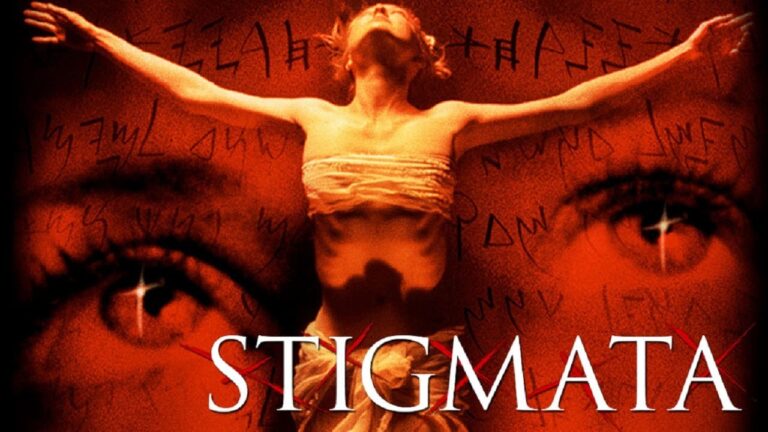
Stigmata (1999) Explained: Why The Vatican Hated This Cult Classic
I still remember the first time I watched Stigmata in a crowded theater in 1999. It didn’t feel like a standard horror movie—it felt dangerous. The Catholic League had already condemned it as “anti-Catholic blasphemy,” and the opening credits, pulsing with Billy Corgan’s industrial rock score, promised something that The Exorcist never delivered: a Vatican conspiracy that felt terrifyingly modern.
Rewatching it 25 years later for this deep dive, I realized two things. First, the critics who slammed it for looking like an “extended MTV music video” were wrong; that gritty, hyper-stylized aesthetic is exactly what makes it a masterpiece today. Second, most people completely misunderstand the ending because the version currently streaming on Netflix is not the one many of us saw on DVD.
In this guide, I’m not just going to recite the plot. I’m going to break down the true story behind the “Gospel of Thomas”, reveal the darker Director’s Cut ending where Frankie Paige actually dies, and explain why this film is the ultimate Y2K fashion mood board.
Whether you are here for the nostalgia or the theology, this is the only guide you need.
⚡ Stigmata (1999) At A Glance
Genre: Supernatural Horror / Religious Thriller
The Vibe: Y2K Industrial Goth meets The X-Files.
Key Song: “Identify” by Natalie Imbruglia (Written by Billy Corgan).1
Controversy: Condemned by the Catholic League for “blasphemy.”
Watch If You Like: The Crow, End of Days, Constantine, or 90s Music Videos.
Plot Summary: The Storyline
Frankie Paige (Patricia Arquette) is a fun-loving, atheist hairdresser living in Pittsburgh. Her life changes when her mother sends her a souvenir rosary stolen from the corpse of Father Alameida, a priest in Brazil who was investigated for “heresy.”2
Shortly after touching the rosary, Frankie is violently attacked by unseen forces, receiving the “Stigmata”—the five holy wounds of Christ:
- The Wrists: Pierced while she is in the bathtub.3
- The Back: Whipped by an invisible lash on the subway.
- The Head: Pierced by a crown of thorns.
- The Feet: Nailed while she is in her apartment.
- The Side: See “The Alternate Ending” below.
Father Andrew Kiernan (Gabriel Byrne), a Vatican scientist who investigates miracles to disprove them, is sent to debunk her case. Instead, he discovers a conspiracy: Frankie isn’t possessed by a demon, but by the spirit of Father Alameida, who is trying to transmit a message the Church wants to destroy.
The “Y2K Aesthetic”: Why the Style Is Iconic Today
While critics in 1999 mocked the film for looking like an “extended music video,” modern audiences are rediscovering Stigmata as a masterpiece of the Y2K Industrial/Goth aesthetic. Directed by Rupert Wainwright, who came from the world of MTV, the film captures a specific “gritty” late-90s look that is currently trending on social media.4
- The Fashion: Patricia Arquette’s wardrobe is the definition of “apocalyptic chic.” Her oversized shearling coats, vinyl pants, animal prints, and messy bleach-blonde hair have become a mood board staple for Gen Z fashion enthusiasts on TikTok and Pinterest.
- The Cinematography: The film uses high-contrast lighting, rain-soaked city streets, and rapid-fire editing to create a kinetic energy that sets it apart from standard slasher films. It doesn’t look like a horror movie; it looks like a Nine Inch Nails video come to life.
The Soundtrack: The Smashing Pumpkins Connection
Part of the film’s enduring cool factor is its score, which most standard reviews completely ignore. The music was composed by Billy Corgan (frontman of The Smashing Pumpkins) along with Elia Cmiral.
The soundtrack perfectly captures the melancholic, electronic-rock vibe of the late 90s. It features the hit track “Identify,” performed by Natalie Imbruglia, which was written specifically for the film by Corgan.5 This musical pedigree gives the film an “alternative edge” that helps explain why it has remained a cult favorite despite negative critical reviews.
Fact vs. Fiction: The Gospel of Thomas
The central conflict of the movie is the “Gospel of Thomas,” a document the movie claims the Vatican is terrified of. But how much of this is real?
| Movie Claim | Historical Reality |
| The Verse: “Jesus said… the Kingdom of God is inside you and all around you. Not in mansions of wood and stone. Split a piece of wood and I am there…” | PARTIALLY TRUE. This is a paraphrase of Logion (Verse) 77 and Verse 3 from the real Gospel of Thomas. The movie combines two verses to make the anti-church message stronger. |
| The Discovery: Found in a cave near the Dead Sea in modern times. | FALSE. The Gospel of Thomas was actually discovered near Nag Hammadi, Egypt, in 1945, not near the Dead Sea Scrolls. |
| The Conspiracy: The Vatican crushed it because it would “ruin the church.” | EXAGGERATED. The Church did reject the Gospel of Thomas, but not because of a conspiracy. They excluded it from the Bible because it is a “Gnostic” text (focused on secret knowledge) rather than a historical account of Jesus. It has been public knowledge since 1945. |
The Alternate Ending: Director’s Cut vs. Theatrical
If you watched Stigmata on TV or VHS years ago, you might be confused by discussions of Frankie dying. That is because there are two completely different endings, and knowing the difference is key to understanding the film’s true message.
Quick Guide: Which Version Are You Watching?
| Feature | Theatrical Cut (Netflix/TV) | Director’s Cut (DVD/Blu-Ray) |
| Frankie’s Fate | Alive. She is saved by the priest. | Dead. She dies in the priest’s arms. |
| The Final Scene | Frankie walking in a sunny garden. | Father Kiernan mourning her death. |
| The Tone | Hopeful and Hollywood-style. | Tragic, dark, and spiritual. |
| The Meaning | Faith survives outside the church. | She becomes a martyr for the truth. |
The Story Behind the Change: Director Rupert Wainwright actually preferred the dark ending, believing it was more powerful. However, test audiences hated seeing Patricia Arquette die, so the studio (MGM) forced the “happy” survival ending for the theatrical release.
Content Caution: Violence & Spiritual Themes
For those sensitive to religious horror, Stigmata is intense.
- Violence: The stigmata sequences are visceral.6 The “wrist” scene involves a knife, and the “feet” scene involves a nail gun. It is bloody and realistic.
- Sexual Content: There is no explicit sex, but there is a scene where Frankie (possessed) attempts to seduce the priest to test his vows.
- Theology: The film takes a hard stance against organized religion (“The Kingdom of God… is not in buildings of wood and stone”). Devout Catholic viewers may find the premise—that the Vatican would hide the words of Jesus—offensive.
Conclusion: A Misunderstood Masterpiece
When I finished my latest rewatch of Stigmata to write this article, I was struck by how much the film’s central message resonates more today than it did in 1999. In an era where trust in institutions is at an all-time low, the idea that “The Kingdom of God is within you”—and not in a building made of wood and stone—feels less like heresy and more like a spiritual truth.
Yes, the movie has its flaws. The rapid-fire editing can be jarring, and the romance subplot feels forced. But unlike the soulless CGI horror films we get today, Stigmata has a texture and a pulse. It dared to mix heavy Gnostic theology with high-fashion aesthetics, creating a film that is visually stunning and intellectually provocative.
My Expert Verdict: If you have only ever seen the theatrical version, you haven’t really seen the movie. Do yourself a favor and track down the Director’s Cut. Seeing the alternate ending where the church fails to save Frankie changes the entire experience from a standard thriller into a tragic, powerful commentary on faith.